INDLEDs / Lumatree guide
How to choose a solid wood pendant light for a dining table or hospitality interior.
A pendant above a shared table has two jobs: it needs to make the table useful, while letting the room remain comfortable and connected. This guide helps designers and project teams choose a solid wood pendant light with the right relationship to the table, the room and the people using it.
Start with the table
Light the shared surface, not just the fixture.
Dining, meeting and reception tables are focal points: people read, eat, talk and work there. The pendant should create enough useful light over that surface without making the source uncomfortable from seated eye level.
A linear form often gives a clearer relationship to a long table than several isolated decorative points. It can also keep the visual language calmer in a restaurant, hotel lounge or residential dining room.
01 / Proportion
Set the pendant in relation to the table.
Begin with the table length, the seat positions and the circulation around it. The pendant needs to sit within the table zone, not extend into the line of sight or a route around the furniture. Installation height should be checked in the actual room, especially where ceilings, artwork or sightlines vary.
- Use the table and seating layout as the first drawing, not an empty room.
- Review the pendant length alongside the visual weight of the table.
- Check seated sightlines at both ends of a long shared table.
- Confirm the final hanging height with the interior team and electrician.
02 / Distribution
Choose direct light, or a second layer for the room.
Downward light focuses illumination where food, documents and conversation happen. A direct-and-indirect pendant can also carry a softer layer upward, helping the ceiling and surrounding volume remain present after daylight has gone.
For Lumatree Pendant, the downward beam is 64° and the optional upward distribution is 160°. The choice should follow the room: a compact dining setting may need only the table, while a deeper hospitality interior can benefit from a more even relationship between table and envelope.
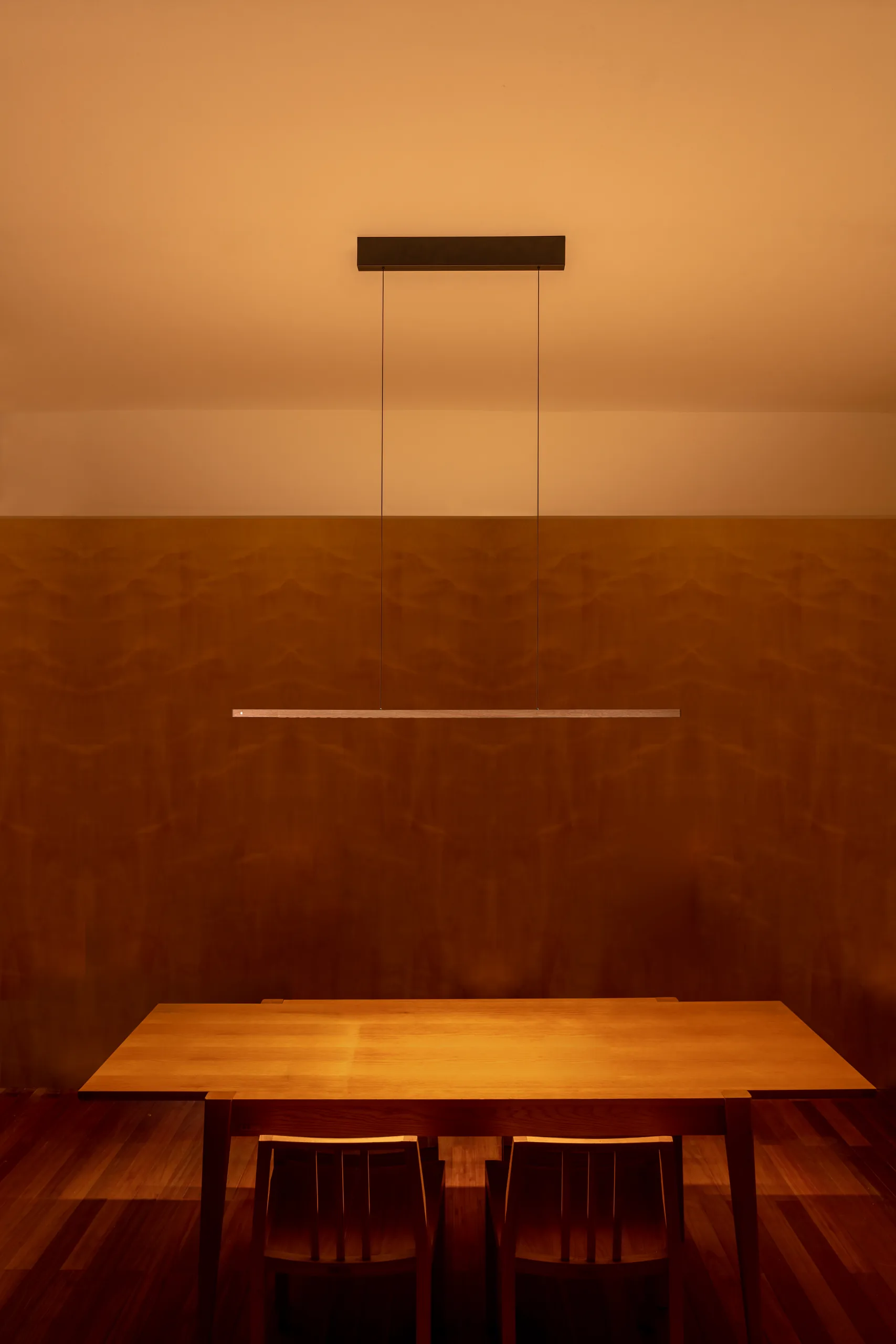
Lumatree Pendant
A material-led line of light.
The Lumatree Pendant pairs a narrow solid-wood section with recessed optics. It is designed for dining tables, meeting rooms and hospitality interiors where timber should sit naturally with furniture and joinery rather than become an unrelated decorative object.
03 / Atmosphere
Specify light quality for the time of day.
Warm colour temperatures normally support dining, lounge and guest settings; dimming allows the room to move from preparation or work into a quieter evening mode. Good colour rendering matters because it helps timber, food and other materials remain believable rather than flat or over-saturated.
Decide the intended atmosphere before the technical schedule is fixed. The colour temperature, control route and direct or indirect distribution need to be coordinated with the room instead of treated as isolated product options.
04 / Project information
Confirm the details before installation.
Request dimensional drawings, photometry, finish samples and the proposed control arrangement early in the project. This gives the interior, electrical and lighting teams a common basis for resolving suspension points, wiring, dimming and final height.
Where a project uses several forms of light, consider the pendant as one role in a coordinated family: table light for gathering, task light for focused activity, and wall or floor light for the ambient layer.